A note on sources: the figures below draw on the Kosovo Business Registration Agency (ARBK, also styled KBRA in English), the Tax Administration of Kosovo (ATK), the Central Bank of the Republic of Kosovo (BQK) and current published tax guidance. Rates and rules are accurate as of early 2026; confirm anything time-sensitive with a local adviser before you file.
Why Kosovo, and why now
The headline case is straightforward. Kosovo runs a flat 10% corporate income tax, an 18% standard VAT, and a 0% withholding tax on dividends — a combination that few EU members come close to. It uses the euro unilaterally, so a foreign parent invoicing in or out faces no currency conversion on the core flows. Its population is among the youngest in Europe, with strong English and a deep, diaspora-fed pool of German speakers — the single hardest language to staff affordably anywhere on the continent.
What has changed is the depth of the operating ecosystem rather than the tax table. A foreign employer arriving today is not a pioneer. Established BPO and technology operators run sizeable Prishtina teams, the professional-services bench is real (Deloitte, PwC and the mid-tier audit and law firms all have local offices), and the supporting infrastructure — banking, accounting, fit-out, recruitment — is mature enough that setup is a process rather than an expedition. The arbitrage on cost remains substantial, but the reason to move now is that the risk of being early has largely gone.
The remainder of this guide is the practical part: structure, registration, tax, banking, people, cost, and the step most foreign employers underestimate — turning a registered company into an operational one.
Choosing your structure: SH.P.K. versus a branch
Most foreign employers establishing in Kosovo choose one of two routes.
The limited liability company (SH.P.K.) is the default, and for good reason. It is a separate legal person, it ring-fences the parent from local liabilities, and — importantly for a small operation — Kosovo law sets no minimum share capital for an SH.P.K. A single foreign individual or a foreign company can own 100% of it; no local partner or nominee is required, and none should be used as a device (regulators have, in documented cases, asked nominee-run companies to prove genuine decision-making substance, which defeats the point and creates risk). The SH.P.K. is the right vehicle for a nearshore delivery team, a support centre, a sales office or a holding-and-operating structure.
The branch office keeps the legal personality with the foreign parent and registers that parent to operate in Kosovo through a branch. It can make sense where the activity is genuinely an extension of the parent and the group wants to avoid a second balance sheet, but it does not give you the liability separation of an SH.P.K., and for most employer use-cases it offers little the SH.P.K. does not.
A third form, the joint-stock company (SH.A.), exists for larger, board-governed or capital-raising ventures and carries a €10,000 minimum capital. It is rarely the right answer for an employer simply standing up a team.
For the great majority of foreign employers, the recommendation is the SH.P.K. The rest of this guide assumes that route.
Registration: the process and the real timeline
Company registration runs through ARBK, which sits under the Ministry of Trade and Industry and operates a digital workflow alongside its service centres. The agency's stated processing time for an SH.P.K. is three business days. In practice, a clean file is often approved in one to two business days, with one to five days the realistic range depending on how the file is prepared.
The documents are not onerous: a founding act or charter, identification (passport or Kosovo ID) for the owners and the authorised representative, evidence of a registered address, and a power of attorney if a lawyer is filing on your behalf. Foreign documents will typically need notarisation and a sworn translation into Albanian.
The single most common cause of delay is not the agency — it is the file. Inconsistent passport name spellings, a middle name that appears on one document but not another, a proof-of-address that does not meet the registry's format, or a missing sworn translation will trigger a rejection and a resubmission. The practical lesson, repeated by every local adviser, is that the timeline is governed by document hygiene, not by bureaucracy. Get the file right once and the three days look generous.
A realistic sequence for a foreign employer looks like this:
| Step | Who | Typical time |
|---|---|---|
| Name check and document preparation | You / adviser | 2–5 days |
| ARBK registration certificate | ARBK | 1–3 business days |
| Fiscal number from ATK | ATK | Days |
| VAT registration (if required) | ATK | Days |
| Corporate bank account opened | Bank | 2–4 weeks |
The headline figure to carry into a board paper is this: the company can be registered in days, but going truly operational — fiscal number, VAT where needed, a working corporate bank account and a compliant first hire — is a four-to-five-week sequence. The bank account, not the registry, is the long pole. Plan around it.
Tax: the rates that actually matter
Kosovo's tax system is simple by design, which is much of its appeal. The figures a foreign employer should hold in mind for 2026:
| Tax | Rate (2026) | Notes |
|---|---|---|
| Corporate income tax | 10% flat | Applies to companies with turnover above €30,000; below that, simplified quarterly tax on gross receipts |
| VAT (standard) | 18% | Registration threshold €30,000 turnover |
| VAT (reduced) | 8% | Water, electricity, central heating, waste services, grains, bread, flour, pasta, cooking oils |
| Dividends | 0% | Exempt for residents and non-residents alike |
| Rental income (withholding) | 9% | Relevant if you lease premises or property locally |
| Personal income tax | 0–10% | Progressive; lower band exempt |
| Pension contribution | 5% + 5% | Employer and employee each contribute 5% |
Two points repay attention because generic guides routinely miss them.
First, the 0% dividend rate combined with the 10% CIT is what makes Kosovo efficient for a foreign parent: profit is taxed once at 10% inside the company, and can then be distributed to the foreign shareholder without a further Kosovo withholding charge. For groups, this is the structural attraction, not the headline CIT alone.
Second, there is a VAT trap for foreign entities. The €30,000 registration threshold applies to locally established businesses. A foreign entity that is not established in Kosovo but begins economic activity there is generally required to register for VAT from the start of that activity, regardless of the threshold. A foreign parent that begins invoicing into Kosovo on the assumption that it has a €30,000 runway can find it has had an obligation from day one. Confirm your position with ATK guidance or a local tax adviser before the first invoice, not after.
Losses can be carried forward for five years, and where a double-tax treaty applies, relief is given by credit up to the Kosovo rate. Kosovo's network here is narrower than an EU member's, so treaty position is worth checking for your specific home jurisdiction.
Banking: opening the corporate account
Banking is where the calendar is decided, so treat it as the critical path rather than an afterthought. Three banks are the practical shortlist for a foreign-owned company.
Raiffeisen Bank Kosovo is the usual first choice for an international parent: the largest network, English-language documentation and reliable SWIFT. ProCredit Bank has the strongest dedicated SME and business-banking proposition and a long track record with smaller corporates. NLB Banka, Slovenian-owned, is a solid regional option. Beyond these, TEB (affiliated with BNP Paribas, strong on cards and SWIFT) and BKT (Albanian-owned, strong cross-border links to Tirana) are credible alternatives.
What every one of them now does is run genuine know-your-customer and source-of-funds review on a foreign owner. Expect to provide group ownership documents, identification, a business description and, often, projected cash flows. This due diligence — not any paperwork at the registry — is why account opening runs to two to four weeks and occasionally longer. Prepare a clean, consistent ownership pack in advance and the bank account stops being the thing that holds up your launch.
Hiring and work permits for foreign staff
Most foreign employers in Kosovo hire locally — that is, after all, the point of the talent pool. But where you need to bring in non-Kosovar staff, the rules deserve a correction to a common assumption.
Kosovo is not in the EU, so there is no freedom-of-movement work right for EU citizens. An EU national has no shortcut over a non-EU national for the right to work long-term. The real distinction is entry, not employment:
- Entry. EU, UK, US and many other nationals may enter visa-free for up to 90 days. Nationals who are not visa-exempt apply for a Visa D at a Kosovo embassy or consulate first; processing typically runs two to four weeks.
- Working up to 90 days in any 180-day period is covered by a work permit.
- Working beyond 90 days — the realistic case for any posted staff member — requires a residence permit, filed with the Ministry of Internal Affairs' Division for Foreigners through the eKosova system. Statutory processing under Law No. 08/L-296 is up to 60 days; in practice 30 to 60 days is normal. The temporary residence permit is valid for up to a year and renewable while the business activity continues, with permanent residence available after five continuous years.
The planning takeaway: budget 30 to 60 days to put a foreign hire on a long-term legal footing, and do not assume an EU passport accelerates it. For the team itself, local hiring is faster and is where Kosovo's economics work hardest.
Costs: what you will actually pay
Founders ask for a single number; the honest answer is a tight band, because the variable is document count and translation, not the registry.
- ARBK registration itself is effectively free — there is no meaningful government registration fee for a standard SH.P.K. filing.
- The real out-of-pocket on a clean file is notary and government items, in the region of €75–125, plus sworn translation of foreign passports and the power of attorney (a modest per-page cost; more owners and more documents mean more translation).
- Professional fees — a lawyer or corporate-services provider to draft the charter, sequence the filing and coordinate the bank — sit on top and vary by scope. They are usually money well spent, precisely because they remove the document-hygiene failures that cause the only real delays.
Set against the ongoing economics — 10% CIT, 0% dividend tax, euro invoicing, salary costs a fraction of Western Europe — the setup cost is immaterial. The figure that matters for budgeting is the working-capital runway across the four-to-five-week setup window, not the registration line item.
From registered to operational: the step most employers underestimate
Here is the gap that catches foreign employers, and it is worth stating plainly. A registered company is not an operating company. Between the ARBK certificate and the first productive day sit the fiscal number, VAT registration where it applies, the corporate bank account and — the part that is easy to defer and expensive to rush — a credible, finished place for people to work.
This is where the calendar usually slips. A team can be hired faster than an office can be designed, fitted and commissioned, and a half-ready space undercuts everything the move was meant to achieve. The pragmatic answer for most foreign employers entering Kosovo is to decouple the office from the build: take fully fitted, serviced space that is operational from day one, prove the team and the model, and only consider a bespoke lease once the headcount and the economics are settled.
"Foreign employers consistently underestimate one thing about Kosovo. The company itself can be registered in days, but going truly operational, with a bank account, fiscal number and first compliant hire in place, takes another four to five weeks. Get that order right and Kosovo becomes one of the fastest, lowest friction entries in Europe."
Egzon Hallaci, Co-Founder, Artana Group
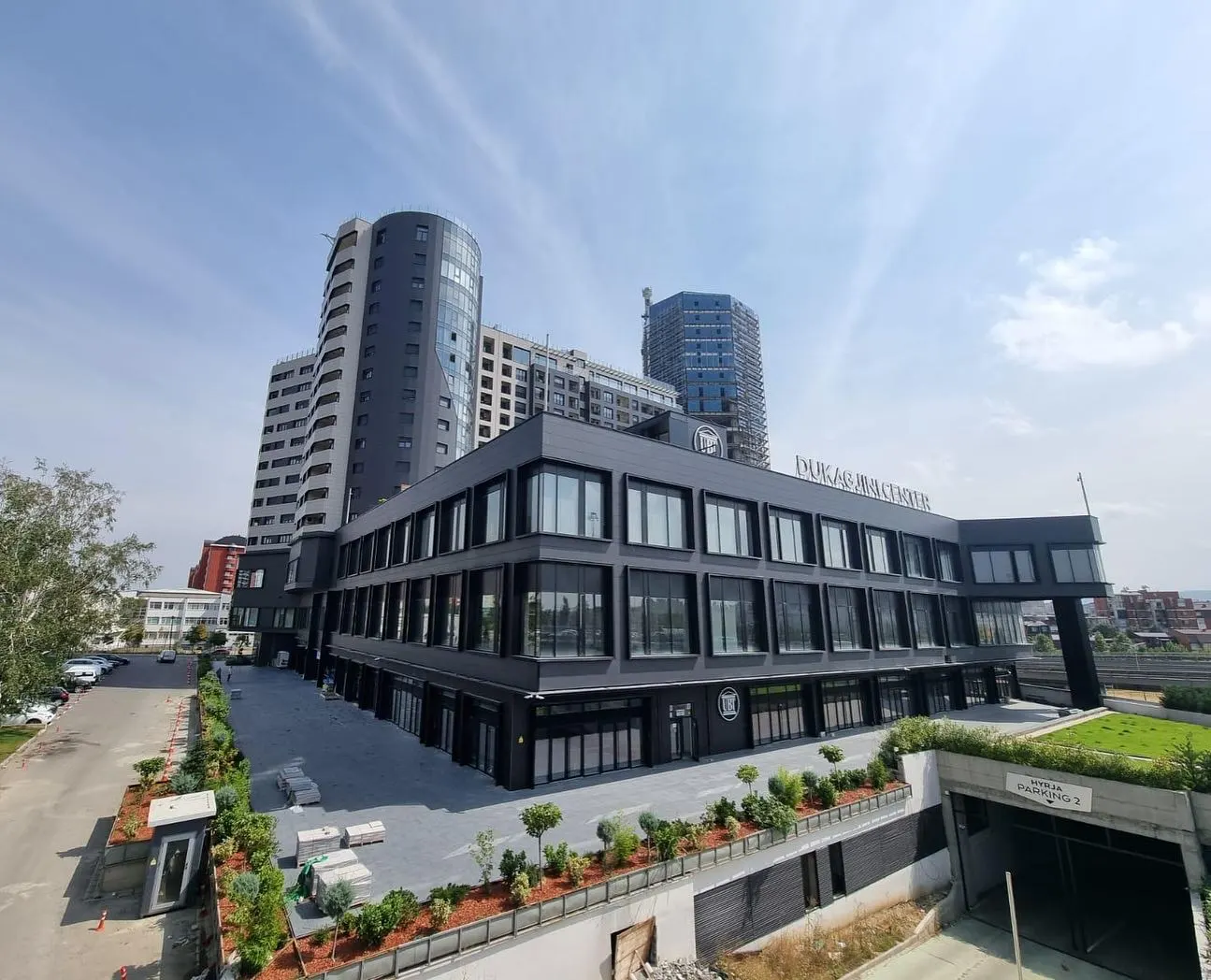
That is the role Artana Group is built for. Its serviced offices in Prishtina and private offices are delivered furnished and connected, with staffed reception and meeting rooms, so the office stops being the critical path. The space sits inside the Dukagjini Centre on Rruga Xhevdet Doda — a mixed-use complex developed by the Dukagjini Group, anchored by the 22-storey Dukagjini Tower, the tallest business-dedicated building in Kosovo. Artana occupies Unit 24 on the second floor, among an established community of professional-services firms; the floor reads as a discrete private suite rather than a door in a crowded corridor, with windows onto the centre's internal atrium. There is staffed reception at the entrance, modern lifts, three levels of underground parking for around 600 cars, and a run of cafés on the lower floors. The complex also houses the campus of UBT College and its roughly 3,000 students — in practice, a graduate hiring pool inside your own building, which is no small thing for a team that needs to scale.
The point is not the address for its own sake. It is that the address removes the last four to five weeks of risk from a Kosovo entry. Register the company, open the bank account, and walk into a finished office the same week your first hires start.
A short checklist before you commit
- Confirm the SH.P.K. is the right vehicle (it usually is); reserve the name and prepare a clean, consistent document file.
- Budget the realistic timeline: days to register, four to five weeks to operational, with the bank account as the long pole.
- Hold the 2026 rates: 10% CIT, 18% VAT (8% reduced), 0% dividends, 9% rental withholding, 5%+5% pension.
- Check the foreign-entity VAT position before your first invoice — the €30,000 threshold may not protect you.
- Line up banking early with Raiffeisen, ProCredit or NLB and prepare the KYC pack in advance.
- Plan 30–60 days for any foreign hire's residence permit; hire locally where you can.
- Decouple the office from the build: take serviced space that is operational from day one.
Kosovo rewards the employer who sequences the entry correctly. Get the order right and it is one of the fastest, lowest-friction places in Europe to put a capable team to work.